Operant Conditioning ABA Therapy – What It Is & How It Works
Operant conditioning is the backbone of Applied Behavior Analysis (ABA).
If you are studying for the BCBA® exam, you will see operant conditioning everywhere: reinforcement, punishment, extinction, shaping, prompting, and behavior change over time. Many students can memorize definitions but still feel unsure when exam questions describe real-life scenarios.Operant conditioning is the foundation of Applied Behavior Analysis (ABA) as defined by the Behavior Analyst Certification Board (BACB).
This guide explains operant conditioning in ABA therapy using clear language, simple examples, and BCBA-style exam tips. The goal is to help you understand how behavior actually changes — not just pass the test, but apply the concepts confidently.
What Is Operant Conditioning in ABA?
Definition (task-list style):
Operant conditioning is a learning process in which the future frequency of a behavior is shaped by its consequences.
- Behaviors followed by reinforcement are more likely to occur again.
- Behaviors followed by punishment are less likely to occur again.
- Behaviors that no longer contact reinforcement may decrease through extinction.
In ABA, operant conditioning focuses on observable behavior and measurable change over time — not thoughts, intentions, or motivation.
If the consequence changes the behavior in the future, learning has occurred.
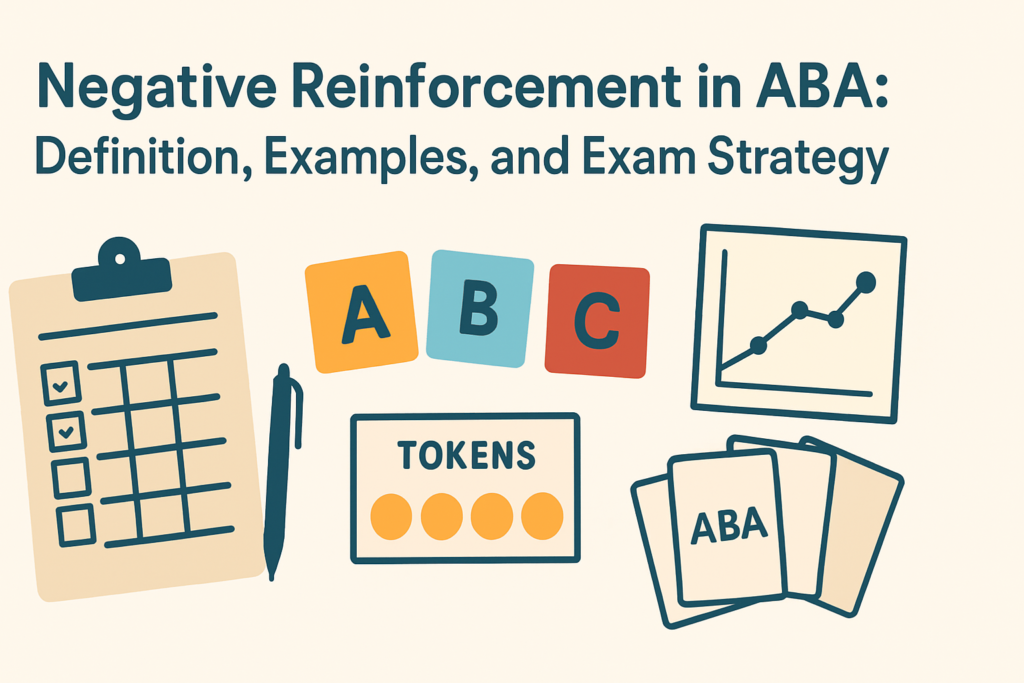
The Basic Operant Conditioning Model (ABC)
ABA organizes operant conditioning using the three-term contingency:
- A – Antecedent: What happens right before the behavior
- B – Behavior: What the person does (observable and measurable)
- C – Consequence: What happens immediately after the behavior
The consequence determines whether the behavior will increase, decrease, or stay the same in the future.
BCBA exam tip: Always focus on the effect of the consequence, not how it sounds. A consequence is only reinforcement or punishment if it actually changes behavior over time.
Reinforcement in Operant Conditioning
Reinforcement is any consequence that increases the future frequency of a behavior. In ABA therapy, reinforcement is the primary method for building skills and reducing problem behavior ethically.

Positive Reinforcement
Positive reinforcement occurs when a behavior increases because something is added after the behavior.
- Behavior → something is added → behavior increases
Example: Child completes work → earns tablet time → work completion increases.
Negative Reinforcement
Negative reinforcement occurs when a behavior increases because something aversive is removed, reduced, or avoided.
- Behavior → something unpleasant stops or is avoided → behavior increases
Example: Student asks for a break → difficult task pauses → appropriate requesting increases.
BCBA exam reminder: Positive and negative reinforcement both increase behavior. “Negative” does not mean punishment.
Punishment in Operant Conditioning
Punishment is any consequence that decreases the future frequency of a behavior.
Positive Punishment
A behavior decreases because something is added after it.
Example: Child hits peer → teacher assigns extra cleanup → hitting decreases.
Negative Punishment
A behavior decreases because something is removed after it.
Example: Teen breaks curfew → phone access removed → curfew violations decrease.
ABA perspective: While punishment appears on the BCBA® exam, ethical ABA emphasizes reinforcement-based interventions first.
Extinction in Operant Conditioning
Extinction occurs when a behavior decreases over time because it no longer contacts reinforcement.
- The behavior previously worked.
- The reinforcement is no longer delivered.
- The behavior gradually weakens.
Example: Child screams to get attention → adults stop responding → screaming decreases over time.
Exam tip: Extinction is defined by withholding reinforcement, not by ignoring or punishment.
Everyday Operant Conditioning Examples (ABA Style)
Example 1: Teaching Communication
- Antecedent: Difficult task presented
- Behavior: Child uses a break card
- Consequence: Task is paused
- Future effect: Use of the break card increases
→ Negative reinforcement strengthens functional communication.
Example 2: Reducing Problem Behavior
- Antecedent: Peer takes a toy
- Behavior: Child hits
- Consequence: Toy is removed and attention is given
- Future effect: Hitting increases
→ Attention and escape may be reinforcing the behavior.
Example 3: Skill Building
- Antecedent: Teacher asks a question
- Behavior: Student raises hand
- Consequence: Teacher calls on student and praises
- Future effect: Hand-raising increases
→ Social praise functions as positive reinforcement.
Why Operant Conditioning Matters in ABA Therapy
Operant conditioning allows BCBAs to:
- Identify why behaviors occur (function)
- Design reinforcement-based interventions
- Teach replacement behaviors
- Reduce problem behavior ethically
- Evaluate treatment effectiveness using data
ABA therapy is not about controlling behavior — it is about arranging environments so appropriate behaviors contact more reinforcement than problem behaviors.
How Operant Conditioning Appears on the BCBA® Exam
Common exam patterns include:
- Descriptions of behavior changing “over time”
- Questions asking whether a consequence is reinforcement or punishment
- Confusing labels meant to distract you (ignore the labels, analyze the effect)
- Scenarios involving escape, attention, access, or automatic consequences
Key exam question to ask yourself:
What happened to the behavior in the future?
That single question will guide you to the correct answer.
Quick BCBA Study Checklist
Before the exam, make sure you can:
- Define operant conditioning in your own words
- Explain the ABC contingency
- Distinguish reinforcement vs punishment
- Identify positive vs negative reinforcement
- Recognize extinction in scenarios
- Analyze behavior change over time
Final Thoughts
Operant conditioning is not just a theory — it is the foundation of everything we do in ABA.
When you understand how consequences shape behavior, BCBA® exam questions become clearer and clinical decisions become more confident. Master operant conditioning, and you master the language of behavior analysis.
This understanding will help you pass the exam, design effective programs, and explain ABA clearly to families, teachers, and staff.
Next step for BCBA exam prep
Turn this topic into exam-day practice
Use this topic as a focused review, then test it in exam-style conditions with a free mock before deciding whether five full-length mocks are the right next step.
Start the Free BCBA Mock ExamContinue with Five Full-Length Mocks — $99
Review the included materials and access details before ordering. No pass guarantee is implied.