
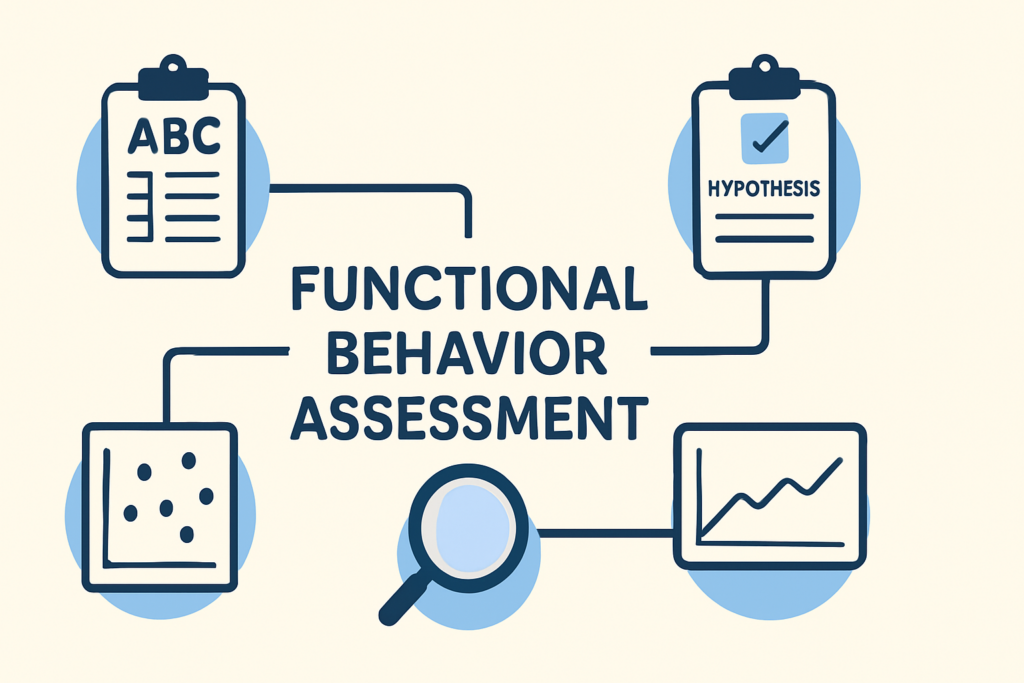
What is a Functional Behavior Assessment? Definition and Core Purpose
A Functional Behavior Assessment is a systematic process for identifying the environmental variables that maintain challenging behavior. This evidence-based approach moves beyond simple observation to develop effective, function-based interventions.
Table of Contents
- What is a Functional Behavior Assessment? Definition and Core Purpose
- The FBA Process in Action: Worked Examples for BCBA Candidates
- FBA on the BCBA Exam: Common Traps and How to Avoid Them
- FBA Quick-Checklist for Study and Practice
- Summary and Next Steps
The FBA Defined: Beyond Just ‘Finding the Function’
An FBA involves multiple assessment methods to form a testable hypothesis about behavior function. It’s not guesswork but a data-driven process that informs intervention design. According to the BACB Task List, this systematic approach is essential for ethical practice.
Indirect vs. Descriptive vs. Functional Analysis: Knowing the Difference
Understanding these three primary methods is crucial for exam success and clinical practice:
- Indirect methods include interviews and questionnaires that gather historical information
- Descriptive assessments involve direct observation using tools like ABC recording or scatterplots
- Functional analysis is an experimental method that systematically manipulates variables to demonstrate causation

The FBA Process in Action: Worked Examples for BCBA Candidates
These practical scenarios illustrate how FBA principles apply in real-world settings.
Example 1: Escape-Maintained Behavior in a Classroom
Consider a student presented with a difficult math worksheet (antecedent). The student tears the paper (behavior) and is sent to timeout, effectively removing the task (consequence). Data collection through ABC continuous recording would show this pattern consistently. The hypothesized function is escape from demands.
Example 2: Attention-Seeking Behavior During Play
During a play session, the therapist attends to another child (antecedent). The target child throws a toy (behavior), and the therapist says ‘stop that!’ while making eye contact (consequence). This scenario demonstrates socially-mediated positive reinforcement through attention.
Example 3: Automatic Reinforcement (Sensory)
In a quiet room with no demands (antecedent), a child engages in hand flapping (behavior). The behavior appears to produce visual stimulation without social mediation. This represents automatic reinforcement, which requires different assessment considerations since the consequence is not socially mediated.
FBA on the BCBA Exam: Common Traps and How to Avoid Them
Exam questions often test your ability to distinguish between common misconceptions and correct FBA principles.
Trap 1: Confusing Correlation with Causation
Descriptive data from ABC recording shows correlation patterns but cannot prove causation. Only a functional analysis with systematic manipulation can demonstrate causal relationships. This distinction is frequently tested on the BCBA exam.
Trap 2: Overlooking Setting Events and Motivating Operations
A thorough FBA considers broader contextual factors beyond immediate antecedents. For example, lack of sleep might serve as a setting event that makes escape-maintained behavior more likely. Understanding establishing operations and abolishing operations is essential for comprehensive assessment.
Trap 3: Jumping to Intervention Before Verifying Function
Ethical practice requires completing the FBA process before designing interventions. An intervention based on an incorrect hypothesis is likely to be ineffective or potentially harmful. Always verify the function through systematic assessment.

FBA Quick-Checklist for Study and Practice
Use this checklist to ensure you’re covering all essential FBA components in your practice and exam preparation.
Your 5-Point FBA Integrity Checklist
- Operationally define the target behavior using clear, observable terms
- Gather data through multiple methods including interviews and direct observation
- Analyze patterns to form a testable hypothesis about behavior function
- Consider the role of motivating operations and setting events in your analysis
- Base intervention recommendations on the hypothesized function rather than topography
Summary and Next Steps
Mastering Functional Behavior Assessment is essential for both exam success and ethical practice. Remember that FBA is not a single method but a comprehensive process that informs effective intervention design. For more on related topics, explore our guide to the four functions of behavior or learn about functional analysis vs. descriptive assessment. The BACB provides additional resources on ethical assessment practices that complement FBA procedures.
Effective FBA implementation requires understanding both the technical components and the ethical considerations involved in assessment. By following systematic procedures and avoiding common traps, you can develop interventions that truly address the maintaining variables of behavior.
Complete BCBA Exam Prep
Turn this topic into exam-day practice
Practice concepts in context with five full-length 6th Edition mock exams, two bonus practice exams, a 6th Edition study guide, and key-term flashcards—all in one $120 USD package.
Get the $120 All-in-One Prep Pack
Review everything included on the product page before ordering. No pass guarantee is implied.



